I was only eleven when Ah Ma1 lost her long and gruelling battle with breast cancer. The year was 1967. Ah Ma left us on the 23rd of April, at the tail end of Yangon's unbearable summer. It is hard to describe the feeling of children without their mother. I could only imagine the pain that Ah Pa2 felt as a husband without his wife. I recognised the sense of smallness in my heart. I knew life would be different, but I could not foresee how difficult it would become.
Ah Pa promptly returned to his job as the manager of Nay Pyi Taw cinema soon after. While he cast a cloak of calmness and positivity onto our household, Eng Eng3 — my oldest sister — was the one who stepped up to the role of homemaker. She was only sixteen then, but our meals and chores were all organised by her. My older brother Lek Lek remained a somewhat carefree child, though I understood that his heart ached no less than mine.
Ah Ma's youngest sister — Zeng Cai E, or Aunty Lily — became a substitute caregiver for us in her absence. Aunty Lily had promised on Ah Ma's deathbed that she would take care of us, especially me — considering how much I used to fall sick as a child. In the care of my family, normal life resumed.
01
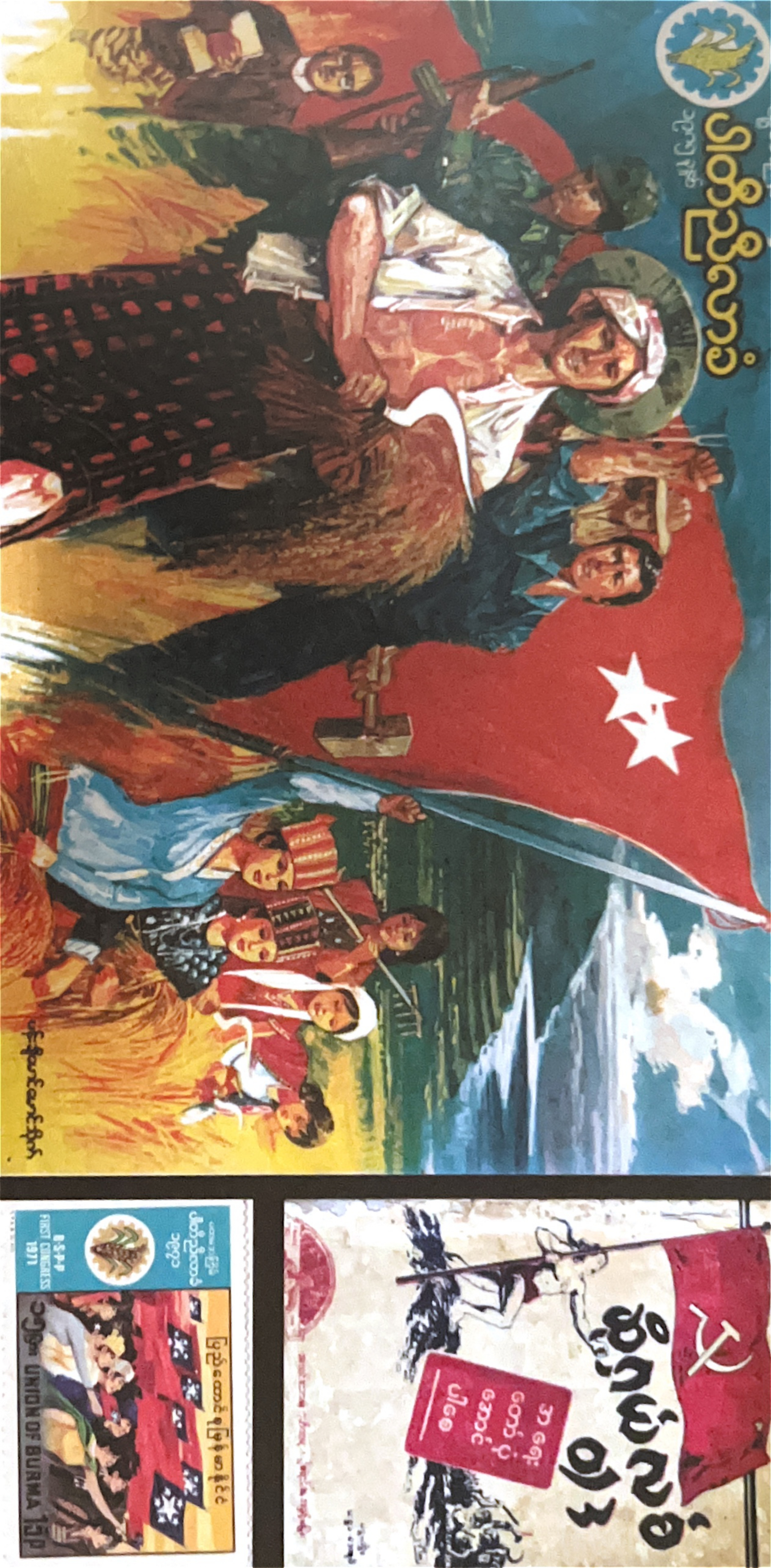
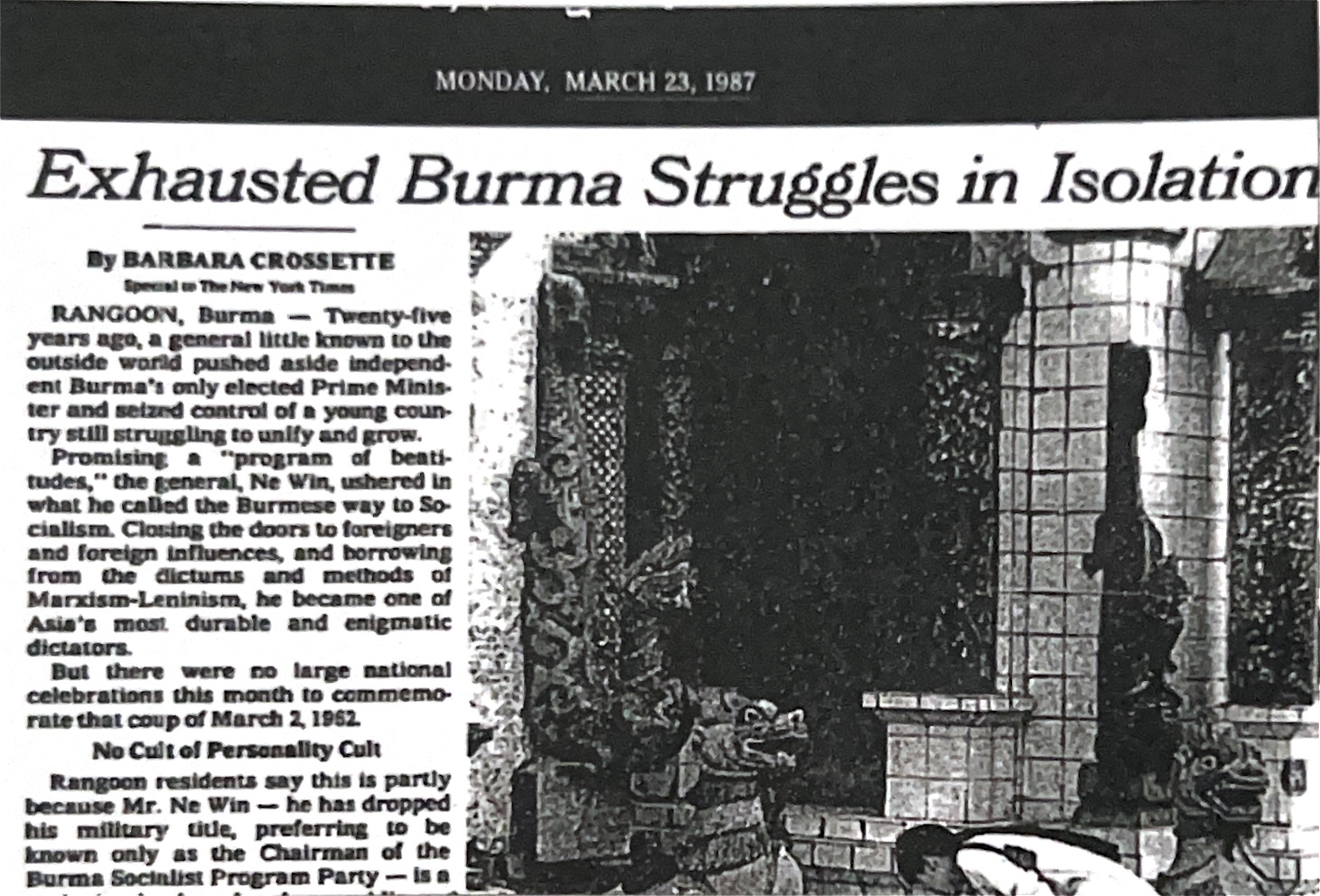
The pain in our home was hidden in plain sight against the harsh backdrop of Ne Win's Burmese Way to Socialism. The ongoing nationalisation of private enterprises brought much hardship to common people across Rangoon as the economy tanked and wages dropped. Rations were in place to control increasing prices on necessities as production plummeted. Everyone was focused on survival.
02
My focus, made clear by Ah Pa, was to keep my head down in school and excel in my studies. Much to his delight, I enjoyed attending the Chinese Girls' Middle School thoroughly. I was in Grade 5 then, and schoolwork was a breeze. On top of that, my teacher recognised good students by rewarding them with the Little Red Book4 and a Mao Ze Dong pin. When I received my reward, I was so proud. Having something so beautiful as my own meant a lot to eleven-year-old me. Not only was I proud to be a good student, I was also incredibly proud to be Chinese.
03
While it held little political meaning to me, the pin was a sign of brewing danger to others. As the military junta strengthened its xenophobic propaganda, the narrative surrounding the Sino-Burmese quickly shifted from friendly Pauk Phaw5 neighbours to opportunistic black marketeers. It was convenient to identify Mandarin schools as the breeding ground for communism. Aggravated by the students' display of "Chinese pride" and wary of China's growing influence, conflict broke out in my school on 22 June.
I am not sure what happened exactly, but a worried Ah Pa came rushing to pick me up from school that day. Amidst the rowdiness, Ah Pa got into a minor confrontation with the Burmese principal. Despite some heated exchange, the altercation ended quickly with both gentlemen backing off and apologising.
04
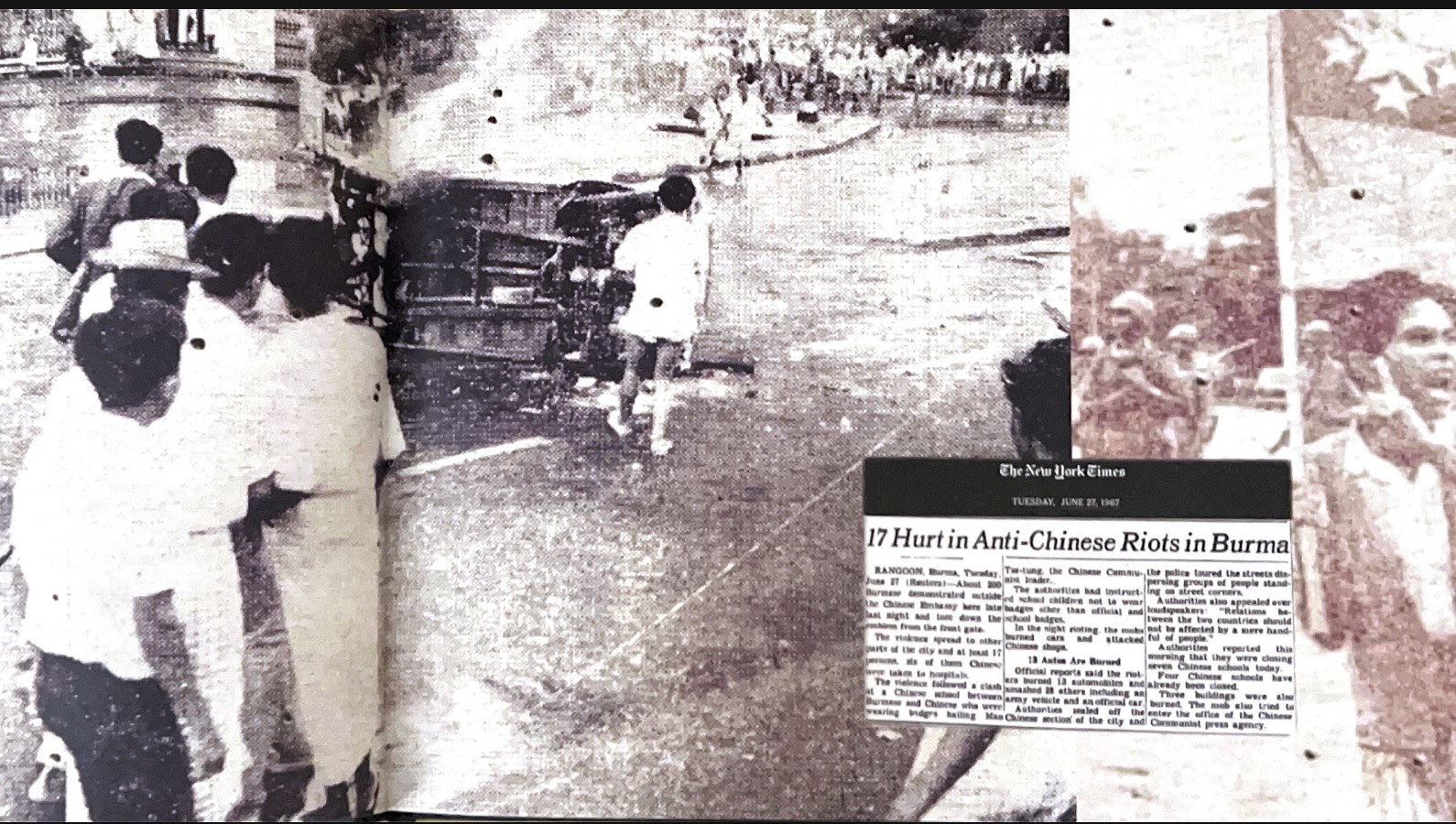
Less than a week later, the situation escalated to what we now know as the 1967 Anti-Chinese riots of Burma. The events of the next few days, from 26 June onwards, have been deeply etched in my brain.
On that fateful night, Ah Pa set out for his usual night stroll. Sensing trouble and unruly crowds on his walk, he quickly went up to seek shelter in his brother's apartment around the corner. From above, he noticed a long-haired man in black pants walking toward the violent mob and quickly signalled for him to come up to hide with him. This man turned out to be an acquaintance — one of the traditional peacock dancers from a clan. That night, Ah Pa saved his life.
Back home, Eng Eng and I were left to worry helplessly. There were no phones then and no way of knowing what was happening outside. Ah Pa was out. Lek Lek was out. We had no idea if they were dead or alive, and all this while, you could hear shouting and the sound of mobs rounding out Chinese folks who dared to come out. We hid in silence and prayed for it to be over. Thankfully, both Ah Pa and Lek Lek returned safe and sound the next morning.
05
Again, trouble came the next night. Mobs — consisting of plain-clothes militia, low-caste Indians and Burmese folks — entered Shwe Dagon Payar Road and started attacking shops and homes on the ground floor that had any Chinese presence. As the situation escalated, our Indian-Muslim neighbour, who I always feared due to his fierce demeanour, went down to the bottom of the stairwell to guard the building. He belonged to a higher caste and commanded respect from the Indians within the mob that night. It was his protection that saved us from a particularly revengeful ex-employee who was fired due to misconduct under Ah Pa's management at the Nay Pyi Taw cinema. To an angry crowd yelling out for Ah Pa's name, our neighbour stood his ground and threatened to reciprocate with violence if anyone dared to touch him. He knew we were in danger and risked his life to protect us.
During the long night, we sought shelter in our neighbour's house. We were quivering with fear and trying our best not to make a sound; we tried to peek through the shutters but could not see much. All we could see were distant shadows of the growing mob, filled with bloodlust and anger. The sounds, though, permeated with ease through the apartment's windows — yelling, glass shattering, screaming. The smell of gasoline and burning lingered. It felt like an endless few hours of terror.
06
The next day, when the chaos subsided, Ah Pa headed off to help out within the community, and the adults pieced together the story of what occurred from the horrific remnants. Seeing that the violence was snowballing, three men from the nearby clan house called out to the mob from their unit on the third floor and started to throw objects and furniture to the ground. Mob members rushed up the stairwell to attack them. The fight between the mob and the three clansmen went on and on for a few hours, keeping the mob distracted enough from the rest of the Chinese households on the street. With severe injuries on their bodies, the three clansmen embraced and jumped to their death as the mob closed in. They saved our street with their ultimate sacrifice. Coincidentally, one of the three clan members was the man Ah Pa had rescued just the night before. Unfortunately, death was already on his cards.
07
We learned in the following days that the riots broke out across various locations in Chinatown and downtown Rangoon. They destroyed businesses, damaged property and, worse, took away more than 30 lives from our community. Depending on each nation's agenda, the news attributed the incidents to various causes — ranging from Ne Win's strategy to distract away from the domestic rice crisis to an early preventative measure of the Communist threat. Regardless of the true objective, we had to face the stark reality that the situation for the Sino-Burmese community had changed drastically. Many felt that they were no longer safe in Rangoon.
08
On 1 August 1967, precisely 100 days after the death of Ah Ma, police came to arrest Ah Pa. He was accused of being a primary instigator in the Chinese "uprising". According to the police, he was responsible for promoting pro-China stances, encouraging students to wear the Mao Ze Dong pin, and gregariously breaking laws. Even more specifically, he was pinpointed as the culprit who attacked the Myanmar principal in my school on 22 June 1967, the catalyst event that sparked the riots. These were all fabrications. Ten more Chinese-Burmese men were detained, including a prominent merchant U Ah Lu who owned the Shwe Htee soap factory. Our world turned upside down.
09
Suddenly parentless, Eng Eng, Lek Lek and I became a combat unit, ready for any obstacles that paved our way. The days and months that followed the riots were tumultuous. Overnight the Sino-Burmese people tried to forget their language and masked their identities as much as possible. Many pronounced their ancestry as ethnic Shan or Wa to avoid scrutiny. Others made the difficult decision to return to China. Chinese schools disbanded and converted to Burmese schools. I was taken out of school for the entire year and reassigned to a Burmese one the next academic year.
10
During this time, we took it upon ourselves to follow Ah Pa's trial as closely as we could. Trips to the Baho Court on Shwe Bon Thar Street and the police station on Bar Street became routine. Seeing three young children waiting for their father, police officers took pity on us — so much that they would allow me to ride in the police vehicle transporting the detainees and even let me slip into the holding cell before Ah Pa returned to Insein prison. On occasion, family members of some of the detainees would cook a feast and bring tiffins to the visiting cell for everyone to enjoy. Three months after the arrest and several infuriating trials later, judges favoured the phoney witnesses who presented doctored accounts and sentenced all the detainers to 7 years in prison. It was an outrageous verdict. Still, Ah Pa refused to be defeated. He dealt with it in his stride and simply looked forward to a time he could return home to his children.
11
In a year, our lives transformed beyond recognition. Even now, the vividness of my memories of 1967 is a testament to its significance in our lives. You can ask my siblings about this painful and unforgettable year. It has profoundly shaped and strengthened us. Our days went by slowly till Ah Pa returned home quietly without notice in 1970 — 34 months after he was captured.
This is the first chapter of My family's personal experiences, a series of stories from the families behind Lahpet Voices, written to be read like a small book — one chapter at a time. It is told in the first person by a contributor who was eleven years old in 1967, recalling the year her family lost its matriarch and then lived through the Anti-Chinese riots of Rangoon.
Names of family members and identifying details have been kept as agreed with the contributor. The account was reviewed and approved for publication under Lahpet Voices' safety and consent policy.
- Ah Ma — grandmother in Southern Chinese dialects like Hokkien, Teochew, and Cantonese, but referring to my grandaunt's mother.
- Ah Pa — grandfather in Southern Chinese dialects like Hokkien, Teochew, and Cantonese, but referring to my grandaunt's father.
- Eng Eng — my current grandmother on my mother's side.
- Little Red Book — Quotations from Chairman Mao Ze Dong, a 1964 book of statements by Mao Ze Dong.
- Pauk Phaw — based on a Burmese term for kinsfolk that implies special asymmetric obligations between Myanmar and China.
This story is not only about 1967. It is about what happens to a family when a country turns against its own people — and about the decisions that follow: to hide, to stay, to leave. My grandparents' generation made those decisions in Rangoon. My parents' generation made them again in the decades since. And the generation after mine is making them right now, in Singapore, Thailand, Malaysia, and the other countries where Burmese people work, study, and raise families.
Lahpet Voices began as an archive of culture — food, music, festivals, history — carried by the Burmese community in Singapore. But culture is not a list of customs. It lives in families: in the meals an older sister organised at sixteen, in the names we use for the people we love, in the language parents keep teaching children in a new country. The migrant workers, students, and diaspora families on this site are not a separate story from my family's. They are the same story, told again and again.
For a community that has learned to bury its languages and mask its identity in order to survive, telling these stories plainly — in our own names or under the protection of anonymity — is itself a form of resilience. This series is my family's way of adding our memories to the archive. It is our way of saying: we were here, we survived, and we are still here.