City Hall MRT is a normal Singapore interchange — you come up the escalator, you turn, and you are facing a little shopping centre with a bank at the corner. Nothing about the outside announces what the building does for thousands of people. You would walk past it most days and think mall, pharmacy, money changer, and that would be that. But on a Sunday, if you know, you cross the road and ride the escalator to the second floor, and right there, past the escalator, is the closest thing most of us have to a living room.
Peninsula Plaza, the food court on the upper floor — it is not on the tourist brochure, and it is not trying to be. The tables are the long plastic kind that come free with every hawker centre in the city. The air smells of cooking oil and lime and the particular warm flatness of air-conditioning full of people. There is a money changer nearby that everyone trusts, a travel counter with flights to Yangon and Mandalay in the window, and an escalator that never seems to carry enough people for the number who arrive. On a Sunday the place hums. It is loud in the way of a place that is full of people who know each other, or want the same news, or are simply glad to be somewhere that sounds right.
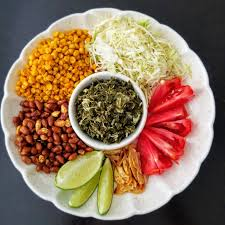
Here is what a table means in this food court. It means you order a laphet thoke and a glass of milk tea and you sit with whoever is already there, and nobody checks whether you were invited, because in a living room everybody is. Someone is reading out a part of the news. Someone else is helping a newcomer figure out the forms for a permit, or which clinic to go to, or how to send money without the fee eating half of it. A phone is passed around so someone on a video call in another country can say hello to someone here. The food is Burmese, mostly, but the thing that makes it a living room is not the food. It is that nobody rushes you away from the table.
I have been told that the food court was not designed for this. It was a business-rate food court like any other, and the Burmese community simply found it, then re-filled it, until the mall noticed and the shops on the ground floor started to change to match who was coming. Now you can find a place that sells the exact spice mix from the family kitchen or the shampoo that is hard to get anywhere else. It is not that the mall built a home for anybody. It is that people built it themselves out of a food court, the way communities do — not by asking, just by showing up so reliably that the space eventually learned to be what they needed.
It matters more now than it did a few years ago. A lot of Burmese people in Singapore have been here long enough to have lost the habit of a home place back in Myanmar, or to be afraid of what going back would mean, or to have no easy way to visit. Peninsula Plaza holds the gap. You go there when you need to feel that you are not the only one, and it works, because you are not. On a Sunday you will see whole families, tables pushed together; you will see someone who just landed with one bag and nowhere to go yet; you will see the elders sitting in the same spot they sat last week, holding court over the tea.
People call it by its nickname, or just the place, and nobody has to explain which place. I do not think there is an official name for what it is — a community centre with no sign, a consulate with no flag. The food court does not do the work of a community by being efficient at it. It does it by being there, every day, and by letting people sit a little longer than a food court technically should, because that is what a room in someone’s home is for.
So if you are new to Singapore, or new to the idea that food courts can be homes, find the escalator up on a Sunday. Order the tea. Sit at whatever table has room. Nobody is going to ask you to leave, because in a living room you do not get asked to leave. You just get to stay — and that, quietly, is the whole point of the place.