
Language
The Burmese script
မြန်မာဘာသာသည် ကမ္ဘာ့ယဉ်ကျေးမှု အမွေအနှစ်တစ်ခု ဖြစ်သည်။
"The Burmese language is part of the world's cultural heritage."
Burmese (မြန်မာဘာသာ) is the national language, written in a script derived from the Mon script of south-east Asia, which in turn came from a southern Indian Brahmi form. The script is round, with very few straight lines, and was originally designed to be scratched onto palm leaf with a stylus.
It is spoken by about 33 million people as a first language, and understood by many more. Burmese is broadly mutually intelligible with the closely related Burmese dialects of the Irrawaddy valley, but not with the Tibetan-Burman languages of the highlands — Shan, Kachin, Chin, Karen, Mon, Rakhine — which are distinct languages with their own scripts and literatures.
Burmese names are usually a single short word for both given name and surname. Unlike Chinese, Korean, or Thai names, there is no family name passed between generations.
Spiritual life
Theravada Buddhism and pluralism
Around 88% of the population practises Theravada Buddhism, the oldest surviving school of Buddhism. The monkhood (the Sangha) is the country's most respected institution; young men in Myanmar traditionally spend time as monks, often before marriage.
Communities across the country practise other religions too. Christians (Baptist, Catholic, and others) make up around 6% of the population, concentrated in Chin, Kachin, and Karen states. Muslims — including Rohingya, Kaman, and Indian-heritage communities — account for another 4%. Hindus, animists, and Bahá'ís make up most of the rest.
"My grandmother is Buddhist. My grandfather is Baptist. We celebrate Thingyan and Christmas in the same week." — A contributor from Yangon
Food
Six dishes that feel like home
Burmese cuisine is built on rice, fish paste, and the sharp flavours of lime, chilli, and green mango. These are the dishes Burmese people ask for, fight over, and teach their children to cook.
Mohinga
Rice noodles in a fish-and-lemongrass broth, often eaten for breakfast. Frequently called the national dish.
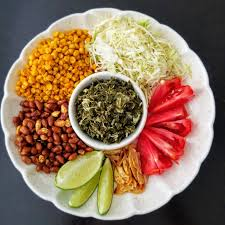
Lahpet thoke
Fermented tea-leaf salad with crunchy peanuts, sesame, garlic chips, and lime. See our recipe →
Shan-style rice (htamin jin)
Tomato-flavoured rice topped with shredded chicken, peanuts, and fresh herbs. Originally a Shan dish, now eaten country-wide.
Lahpet naing
Pickled tea leaves served with assorted sides — the centrepiece of a traditional Burmese meal, and a metaphor for the country itself.
Shwe yin aye
A sweet, coconut-milk dessert of agar jelly, bread, and semolina dyed with food colouring. Sold at small stalls and at every monastery festival.
Ohn no khao swè
Coconut chicken noodles, an adaptation of the Shan noodle soup with coconut milk, often served at Muslim-run teashops.
Festivals
The year, marked by light and water
The Burmese calendar is rich with festivals and monastic holidays. Many Burmese people abroad try to keep at least the major ones.
Thingyan (April)
The Burmese New Year, celebrated with water-throwing in the streets. Symbolically, the water washes away the bad luck of the previous year.
Kathin (October)
Monks receive new robes at the end of the rainy season retreat. Communities organise the offering together.
Thadingyut (October)
The festival of lights, marking the end of Buddhist Lent. Houses, streets, and pagodas are illuminated with candles.
Tazaungdaing (November)
The festival of robes, famous for hot-air balloons lit and released at night in Taunggyi.
Art
Puppetry, dance, and music
Burmese marionette theatre (yoke thé) emerged in the Konbaung period and was once performed at royal courts. The puppets are controlled by a single string and are sculpted with remarkable detail. The art form all but disappeared in the late twentieth century; small revival groups, often based in monasteries, are keeping it alive.
Classical dance is taught in a few schools in Yangon and Mandalay, and in shadow form in the diaspora. The Burmese orchestra (hsaing waing) is built around the drum circle and pat waing (a set of tuned drums played with the hands); the saung — a graceful arched harp — is sometimes called the national instrument.
Traditional dance movements — the slow flex of the knee, the side-glance of the eye, the controlled sweep of the wrist — are still part of how Burmese people move through the world, even at the supermarket.
Dress
Longyi & thanaka
The longyi is a single piece of cloth, usually cotton or silk, wrapped around the waist and tucked at the side. It is worn by everyone, daily, in cities and in the countryside. It is also unisex — the only real difference between the men's paso and the women's htamein is the way they are folded.
Thanaka is a pale yellow paste made from ground bark, applied to the face (and sometimes the arms) in decorative patterns. It cools the skin in the heat, protects against the sun, and is considered beautiful. You will see it on women, men, children, and elderly people in Myanmar, and on Burmese people abroad when they can find the bark.
Family
Names, elders, and respect
Burmese names have no surname. Children are usually named after a quality their parents wish for them — e.g. Aung (successful), Su (kind), Zaw (bright). The day of the week they are born is sometimes added as a prefix: Maha for Monday, Kaung for Tuesday, Sa for Wednesday and so on.
Respect for elders is expressed through small gestures: lowering the body when passing in front of them, offering both hands when giving or receiving something, using honorific particles (ရှင်, sīn) when speaking. In return, elders are expected to be warm, generous, and present.
Extended family often lives together or near each other. Aunts and uncles are addressed with specific terms, not by name. Grandparents, especially on the maternal side, are often the closest in everyday life.
Architecture
Stupas, monasteries, and teak
The Burmese stupa (zedi) is the country's most recognisable form. The earliest survive from the Pyu period; the most famous — the Shwedagon in Yangon, the Shwezigon in Bagan, the Kuthodaw in Mandalay — have been rebuilt many times over the centuries. The shape is said to evoke the bowl of water, the seat of the Buddha, the dome of the cosmos, and the path to enlightenment, all in one.
Burmese monasteries are usually built of teak, raised on stilts, with steep, layered roofs. Inside, the main hall has a large Buddha image and low platforms where the monks sit. Monasteries are open to the public during the day; laypeople often stop in for a few minutes of quiet.
Vernacular houses are still made of teak and bamboo, raised on stilts against the monsoon. The teak floors are polished with a wooden block until they shine.
Literature
Poetry, monks, and the moderns
Classical Burmese literature was written largely by monks and by court poets. The Yaduana Bonzeik Yazawin, an 18th-century verse chronicle, is still read aloud. The Jataka tales — stories of the Buddha's previous lives — have been retold in Burmese verse for centuries.
Modern Burmese literature is at its strongest in poetry. The experimental poets of the 1930s (Tin Moe, Khin Aung) and the post-independence generation (Maung Pyi Min, Aung Cheimt) gave Burmese letters a distinctive modernist voice. After 1988, with most state publishing controlled, much of the country's new literature was produced in exile — in journals, samizdat, and in the diaspora.
Foreigners sometimes ask for a Burmese novel to start with. A common suggestion is The Shell by a Burmese author writing in English, or the works of the late U Myint Thein, who wrote about the borderlands.
Customs
Hospitality, tea, and small gifts
Burmese hospitality is warm and low-key. Guests are usually offered tea at least once, and a small meal if the visit is in the evening. Refusing food entirely is unusual; accepting a small portion is usually the right compromise.
Tea is central. Lahpet, the Burmese word for tea, also means "green" and is the colour of the fermented tea leaves that anchor the national dish. To offer tea is to offer a welcome.
When visiting someone's home, small gifts are usual: fruit, sweets, or a drink. Gifts are usually presented with both hands, and not opened immediately unless the giver insists.
Etiquette
Heads, feet, and other pointers
A few practical points, especially for visitors to monasteries and homes:
- Shoes off at the entrance to temples, monasteries, and most homes.
- Head & feet. The head is the most sacred part of the body; the feet the least. Avoid pointing feet at people, images, or books.
- Monks & women. Women should not touch monks or hand things directly to them. Place items within reach.
- Photos. Ask before photographing people, and never point a camera at a monk's face.
- Noise. Burmese social life is generally quieter than its neighbours. Loud voices in public are unusual.
None of these rules are rigid. A visitor who removes their shoes, is polite to elders, and accepts a cup of tea will be welcomed almost anywhere.
“The Burmese way is to under-promise and over-deliver.” — A Singaporean friend who has lived in Yangon
Diaspora
What people carry
Burmese communities abroad — in Singapore, Malaysia, Thailand, Australia, the United Kingdom, the United States — keep culture alive in small, daily ways. Lessons in Burmese language and dance on Sundays. Monastic visits at Thingyan. Whatsapp groups with the aunties. Plastic containers of mohinga paste flown up by hand.
What changes in the diaspora is the audience. A longyi might be worn less often. A meal might be fish-free on Fridays. Burmese might be spoken at home and a different language at school. The habits that survive are the ones that are loved most: the tea, the dishes, the festivals, the names.
What Burmese people abroad often say they miss is not one thing in particular, but the small density of references — the way a single word can call up a whole afternoon, a whole family, a whole country.