
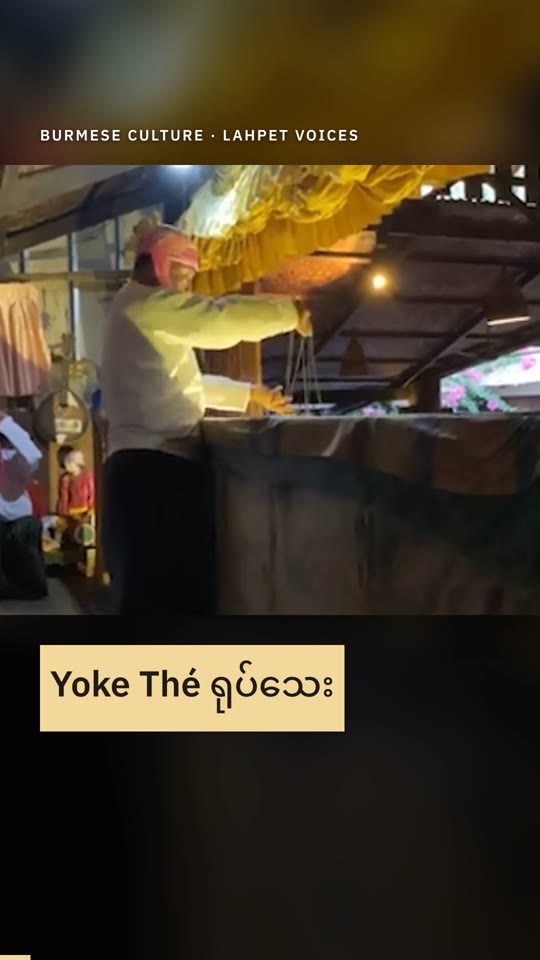

What yoke thé is
Yoke thé (ရုပ်သေး) is Burmese marionette theatre. The name means something like "miniatures". The puppets are carved from wood, dressed in silk and sequins, and hung from a bar the puppeteer holds from a bridge above the stage. A male puppet usually has 18 strings and a female puppet 19, so one puppet can bow, kneel, dance and turn its head. Each puppet has one puppeteer, who often speaks the character's lines as well.
A show is really a Burmese opera played by puppets. A hsaing waing orchestra of drums, gongs and oboe plays below the stage, and the story is often taken from the Buddha's past lives or from court history.


An art of the royal court
Most histories date yoke thé as we know it to the Konbaung court in the late 1700s, around 1780, under King Singu. The man usually credited is U Thaw, the king's Minister of Royal Entertainment. He settled the troupe of 27 characters that puppeteers still use: royalty, ministers, a hermit, ogres, a clown, and animals from horses to elephants.
Our reel says puppetry is more than 500 years old. Some accounts do trace puppet shows in Burma back to the 1400s, but the evidence for anything that early is thin. What's certain is that by the late 1700s the puppets were part of court life, and that they stayed popular for about a hundred years after that.


Saying what people couldn't
At court, a puppet could say things to the king that a person couldn't. Kings used puppet plays to scold their own children or wives with stories that only people inside the palace would fully understand. In the other direction, a play could carry a complaint from the street to the throne, wrapped up as a story about somebody else.
That double meaning is what our reel is about. In more recent times, the puppet stage again became a fairly safe place for satire, a way to laugh at the powerful without anyone saying anything outright.

Nearly lost
When the British took Upper Burma in November 1885 and sent the last king, Thibaw, into exile, the court that had paid for the puppets went with him. Troupes kept going for a while at festivals and pagoda fairs, but over the twentieth century the art shrank to a handful of families and companies.
It came back in the late 1990s, partly with official support, and partly because tourists wanted to see it. Today there are shows in Mandalay, Bagan and Yangon, and newer productions mix puppets and human dancers on the same stage.


The strings that guide it
The saying in our reel is usually taken to mean that nobody gets by on their own.
Burmese families are now spread across Singapore, Thailand, Malaysia, Japan, the United States and further, and very few of them live anywhere near a puppet show.

Where to see it
In Myanmar, the best-known company is the Mandalay Marionettes Theatre, and there are regular shows in Bagan and Yangon. Outside Myanmar, performances are rare. If you know of one in Singapore or anywhere else, or if someone in your family ever worked a puppet, please tell us. We'd like to record it.