
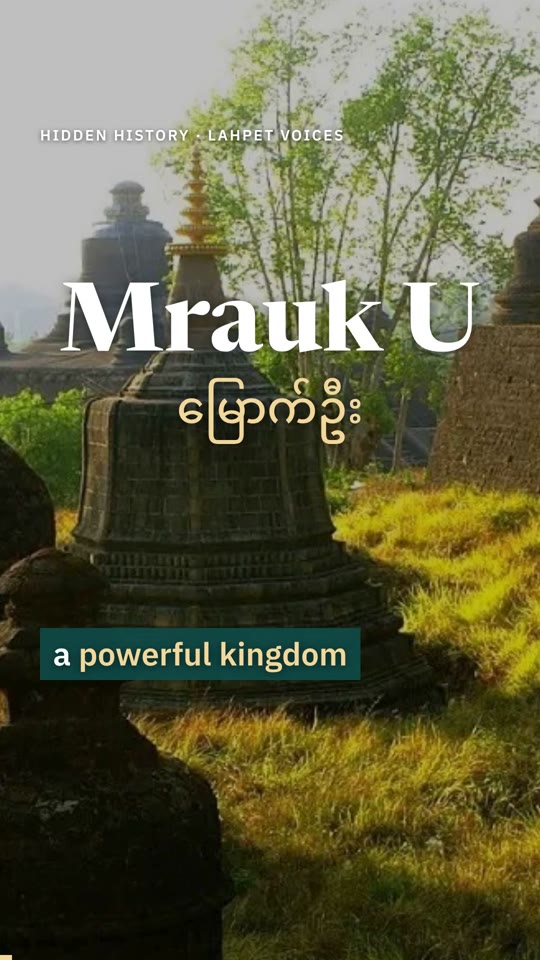


A kingdom on the coast
Mrauk U (မြောက်ဦး) was the capital of the Arakanese, or Rakhine, kingdom from about 1430 until 1785. Its founder, Min Saw Mon (also known as Narameikhla), had spent years in exile in the Bengal Sultanate and took back his throne with Bengali help. For its first years the kingdom owed Bengal loyalty, and its kings used Islamic titles alongside Buddhist ones even after it became fully independent.


Rakhine sits on the Bay of Bengal, cut off from the rest of Myanmar by the Arakan mountains. That made it look west and out to sea as much as east to the Burmese kingdoms on the Irrawaddy.
Canals and stone temples
The city was built among low hills, with canals and tidal creeks running through it, which is why European visitors later compared it to Venice. Its temples were built of stone, not brick. Some of the biggest, like Shitthaung and Htukkanthein, have thick walls and narrow passages, and look as much like fortresses as shrines.


Coins in three scripts
Mrauk U's kings minted their own silver coins. Before 1638, many carried Rakhine writing on one side, and Persian and Nagari (an Indian script) on the other. That one coin tells you who the kingdom traded with, and who it wanted to be taken seriously by.


A port for the whole Bay of Bengal
Rice, cotton, ivory, elephants and spices went out through Mrauk U's ports. The Dutch East India Company started trading there in 1608 and had a trading post in the city by 1610. The kings hired Portuguese mercenaries to run their warships, and are said to have paid well for Japanese warriors as bodyguards.
Not all of that trade was in goods. From the 1530s to the 1620s, Arakanese raiders and Portuguese pirates seized people from the Bengal coast and sold them as slaves, some of them to the Dutch. It's part of the story that's easy to leave out of a short film, so we're putting it here.


1784 to 1785
In December 1784 the Burmese king Bodawpaya sent an army of more than 20,000 men across the Arakan mountains under his son, the crown prince Thado Minsaw. Mrauk U fell on 2 January 1785.


The last king, Maha Thammada, was taken to the Burmese capital, Amarapura, with his family, and died there as a prisoner about two years later. The Mahamuni Buddha, the most sacred image in Arakan, was carried off as well. It now sits in the Mahamuni Pagoda in Mandalay, where people still come every morning to watch its face being washed.


Tens of thousands of Arakanese fled west. One estimate puts the number at about 35,000 people reaching the Chittagong area of British Bengal by 1799. The unrest along that border was one of the things that led to the first war between Burma and the British in 1824.
What's left
Today more than 700 temples and pagodas stand among the rice fields and hills where the city used to be. Myanmar has put Mrauk U forward for UNESCO World Heritage status. Rakhine State has also been badly hit by conflict in recent years, and very few visitors get there now.


If your family is from Rakhine and you'd like to tell its story, get in touch.