


In the 34 months that Ah Pa1 was away, I could only remember the countless trips we took from the city to the prison, the police station, and the court. All this time, my siblings and I were like lost sheep.2
My childhood was happy-go-lucky. I grew up surrounded by playmates on my street. They were neighbours, cousins, and friends of friends. It was a lot of fun growing up in Chinatown. My parents were pretty hands-off and rarely nagged at my siblings or me. It was quite a blissful existence in my younger days.
Of course, all of this changed in 1987. My sisters and I lost both of our parents — one to disease and the other to prison. Life became topsy-turvy. In the 34 months that Ah Pa was away, I could only remember the countless trips we took from the city to the prison, the police station, and the court. All this time, my siblings and I were like lost sheep. Those days were excruciating.
While Ah Pa's return brought relief and joy back to our home, hope evaded me. I was lost and listless from the despair of a failing country and the grief of Ah Ma's3 death. For five straight years, I failed Grade 10. In retrospect, it was miraculous that the school even allowed such a terrible student to remain enrolled. Back then, I would rather spend hours at the tea shop with friends than attend classes. Throughout my insufferable teenage adolescence, Ah Pa never once scolded or spoke unkindly to me. And perhaps it was his unyielding and unique way of parenting that finally persuaded me to change my ways.
Before I started Grade 10 for the sixth time, Ah Pa said, "If there is one thing you need to do well, it is to finish your education." That was it. His guidance was simple and truthful. A good foundation in education allowed him to seek knowledge freely in an environment that did not promote learning. Education enabled him to be an independent thinker and earn his place in society. I understood how much Ah Pa valued education and did not want to fail him. I finally passed that year and was accepted into a bachelor's programme in Economics.
Fate rewarded me when it led to May Kyowl. She was my batchmate in university, six years my junior. When we graduated in 1980, I asked her to marry me. We tied the knot the very next year.
I have always been fortunate not to worry much about finances or work. However, starting my own family was different, and I knew I had to provide for them. My sister Eng Eng4 was running a successful stall in the Saint John market, so I asked her for advice. She showed me the ropes, and I opened another booth in the same market, selling cosmetics and garment accessories. The business helped me start on a sound footing.
Ah Pa, A Daw Gyi5 (his long-time domestic helper), and her son, Maung Maung Oo, stayed with us in a shophouse on Shwe Dagon Payar Road. May Kyowl and I had our first child, Lu Yi, in 1982. She was the apple of Ah Pa's eye. Unfortunately, Ah Pa left us on Valentine's Day in 1984 and did not live to see us welcome our second and third — Kai Kai and Zhen Zhen.
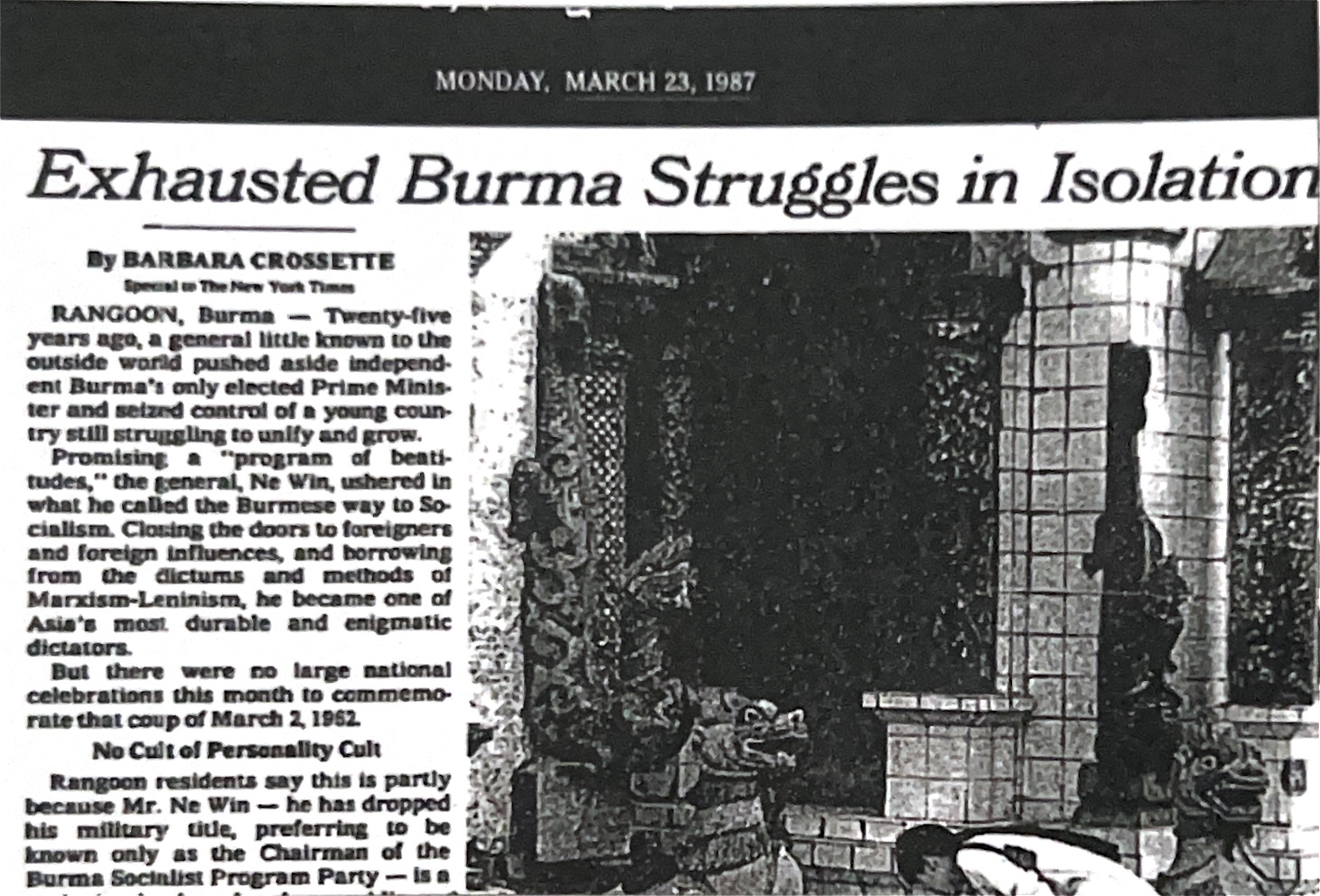
A few years later, a catastrophic uprising occurred in Myanmar. Following 26 years of widespread oppression under the military junta's rule, Myanmar had become one of the world's most impoverished countries. Everyone lacked opportunity, and the economy was in shambles. People were upset and desperate for change. On 8 August 1988, hundreds of thousands of civilians, mainly led by students, took to the streets to protest the government. In response, the junta strengthened its stance and launched a bloody attack against the innocent public. Many students were arrested or, worse, killed. Schools shut down. Once again, our future became uncertain.
The following year, I had the opportunity to visit my sister Mei Mei6 in Singapore. It was eye-opening. I spent a few days sightseeing and exploring the local heartlands. The fantastic innovations and development that Mei Mei talked about in her calls and letters all came to life. The buses and trains were highly accessible and could bring you to any corner of the island nation. Though I did not speak good English, I could still communicate in Mandarin and Hokkien in most situations.
Out of all the marvels, I was most impressed by the education system in Singapore. Mei Mei had a young son, Ronald. Every day after school, Ronald would tell us about his day and entertain us with new songs and dances that he had learnt. I was amazed at his eloquence. He was barely two years old. Compared to the average child in Myanmar, Ronald was way ahead. His environment was far better than what Yangon had to offer. His teachers were much more qualified, and his curriculum was world-class. As a father, I also wanted my children to have this education. I was certain. We had to move to Singapore.
With the 8888 uprising7 fresh in my mind, and my late father's conviction in a good education, I believed it was the best decision for my children. There were just two crucial things to address — how do we completely unroot from Yangon, and what will we do in Singapore?
The former was more straightforward. Since we needed funds to start our new life in Singapore, we had to sell everything in Yangon. In a matter of weeks, we sold our stall in Saint John Market and all of our inventory. Then, we tried to sell all our furniture and personal items in our family apartment. We were lucky that our neighbours bought everything. Even the used bathroom rags. People in Yangon honestly had very little back in the day.
The latter was challenging. Given the higher cost of living in Singapore, my savings were insufficient to sustain my family with three school children. Mei Mei was worried about this. It had been a good decade or so since I graduated from college, and I would need presentable work experience on my résumé to be competitive for well-paying jobs in Singapore. Mei Mei was also feeling rather burnt out from working for a problematic manager in her laboratory. Considering these factors, she suggested we do what we knew best — business.
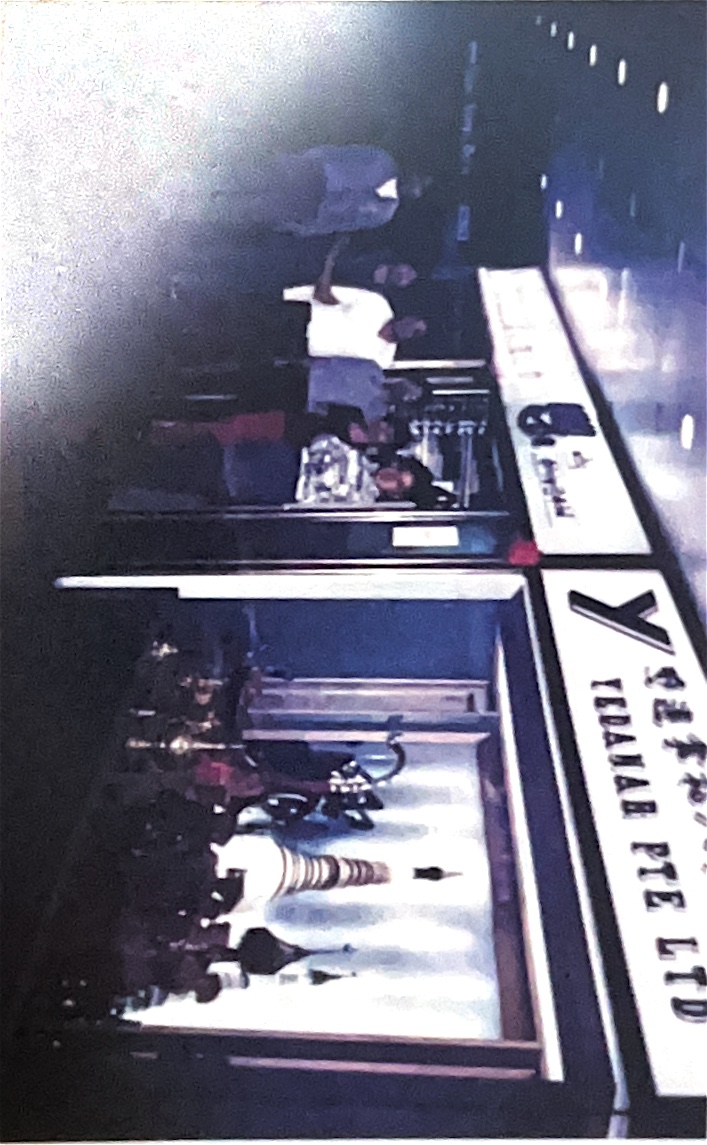
I did not need much convincing. I understood how to run a business instinctively and had already accrued years of operational experience from Saint John Market. In those days, there were not many Myanmar-operated businesses in Singapore, but there was an apparent demand to support Myanmar workers. In particular, workers and seamen needed to regularly remit money and buy items they could not easily find in Myanmar due to limited imports. With our sister Eng Eng and her husband serving as our Yangon counterparts, we founded "Yedenar Pte. Ltd." in 1990.
The first few years of Yedenar were arduous but exhilarating. My siblings and I had to figure it out as we went along. Mei Mei chose to locate our new business in Peninsula Plaza in City Hall, away from other similar businesses in Chinatown's People's Park Centre. There was only one other Burmese store in Peninsula Plaza when we first moved in. This decision meant few of the Burmese diaspora in Singapore knew of us initially. There were days when we did not make any sales.
We gave it our all to run the business and grow it. Yedenar was open seven days a week. Mei Mei and I worked six days each, taking an alternate day off on the weekend to spend time with our families. Our days were long. We served customers during the day and did administrative work at night. The screeching of faxes attempting to reach Yangon was the soundtrack of our store. In time, our store gained an excellent reputation.
While it was tough for my wife to adapt to Singapore at first, the children thrived in their new environment. As a husband, I am grateful for my wife's sacrifice. As a father, I cannot ask for much more than seeing my children happy. Looking back at the various chapters of my life, I cannot say I have made it to where I am today due to my intelligence or extraordinary talent. But I can tell you this — I am one lucky man.
About this story
This is the third chapter of My family's personal experiences, a series of stories from the families behind Lahpet Voices, written to be read like a small book — one chapter at a time.
This chapter is a record of family history gathered through an interview that the author conducted with a senior member of their family — the narrator of this first-person account. It was then structured, lightly edited for clarity, and framed with chapter headings and notes in collaboration with the narrator. It is told in his own voice, in the first person, and every line was reviewed and approved for publication under Lahpet Voices' safety and consent policy.
Names of family members and identifying details have been kept as agreed with the contributor.
Notes
- Ah Pa — the narrator's father, whose conviction in education becomes the turning point of this chapter.
- Opening refrain — the opening lines of the interview are the narrator's own words, framing the chapter around the year their household fell apart.
- Ah Ma — the narrator's mother, who died before the family's move to Singapore.
- Eng Eng — the narrator's sister, who ran a stall at Saint John market and later became Yedenar's Yangon counterpart.
- A Daw Gyi — the family's long-time domestic helper.
- Mei Mei — the narrator's sister, who had settled in Singapore and co-founded Yedenar with him.
- 8888 uprising — the mass, nationwide pro-democracy protests in Myanmar that began on 8 August 1988 and were violently suppressed.
A word from the author
Read against the earlier chapters, this one completes a picture. My grandmother supplied from a four-by-four stall; her child took that same instinct to provide and carried it across borders. Where the first chapters describe surviving Ne Win's Burma from the inside, this chapter is about the moment a generation decided that survival was no longer enough — that their children deserved an education the country of their birth could not give them.
The narrator does not dramatise the decision to leave. He lists it plainly: the uprising, the father's belief in schooling, the cost of living, a sister who suggested business. And then, in a matter of weeks, everything in Yangon was sold — even the used bathroom rags. It is a quiet record of how millions of families weigh a whole life against the futures of their children, and choose the children.
Today Yedenar still sits in Peninsula Plaza, its faxes long replaced, serving the Burmese community that now fills the building. This chapter is how I honour the particular luck my family was given — the sister already in Singapore, the market skills, the clean passage — by keeping the record of what it cost, and of the one belief that carried them: that to give your children a better education than you had is a kind of love. That, and the plain self-assessment by which this narrator closes: not genius, not talent, just a man who stayed for his family and got the chance to say, I am one lucky man.